Getting paid from international clients is one of the biggest challenges for freelancers in Nigeria.
PayPal does not let Nigerian freelancers receive money. Bank wires are slow and expensive. So freelancers need a setup that actually works in 2026.
Here is how Nigerian freelancers are getting paid, with USDT as the payout that moves fastest.
Why USDT Works for Nigerian Freelancers
USDT is a stablecoin pegged to the US dollar. For freelancers in Nigeria it solves several problems at once:
- It moves in minutes, not days
- It does not need a domiciliary account
- It holds its value against the naira
- It is already widely used and understood across Nigeria
Instead of waiting on a wire or fighting with a payment platform that does not support the country, you get paid in USDT and stay in control of your money.
Step 1. Separate “Getting Paid” From “Withdrawing”
These are two different steps and freelancers often confuse them.
Getting paid is how your client sends money. Your client can pay with a card, PayPal, or crypto through a single invoice link. They use whatever is easy for them.
Withdrawing is how that money reaches you. For freelancers in Nigeria, the payout is USDT.
Once you see these as two separate steps, the whole process gets simpler.
Step 2. Use Professional Invoicing
One of the biggest mistakes freelancers make is asking for payment informally.
Instead of sending “Please send me payment,” use a professional invoice with a clear service description, amount, and a payment link.
This builds trust and gets you paid faster. Clients take you more seriously when you present yourself professionally.
Step 3. Give Clients Flexible Payment Options
Clients prefer convenience. If you force one payment method on them, you risk delays.
The better approach:
- Send a clear invoice with a payment link
- Let the client choose how they pay (card, PayPal, crypto)
- Keep the checkout simple
With Payxem you can offer multiple payment options from a single invoice link, then take your payout in USDT.
Step 4. Track Every Payment
Many freelancers lose track of:
- What is paid
- What is pending
- What fees were deducted
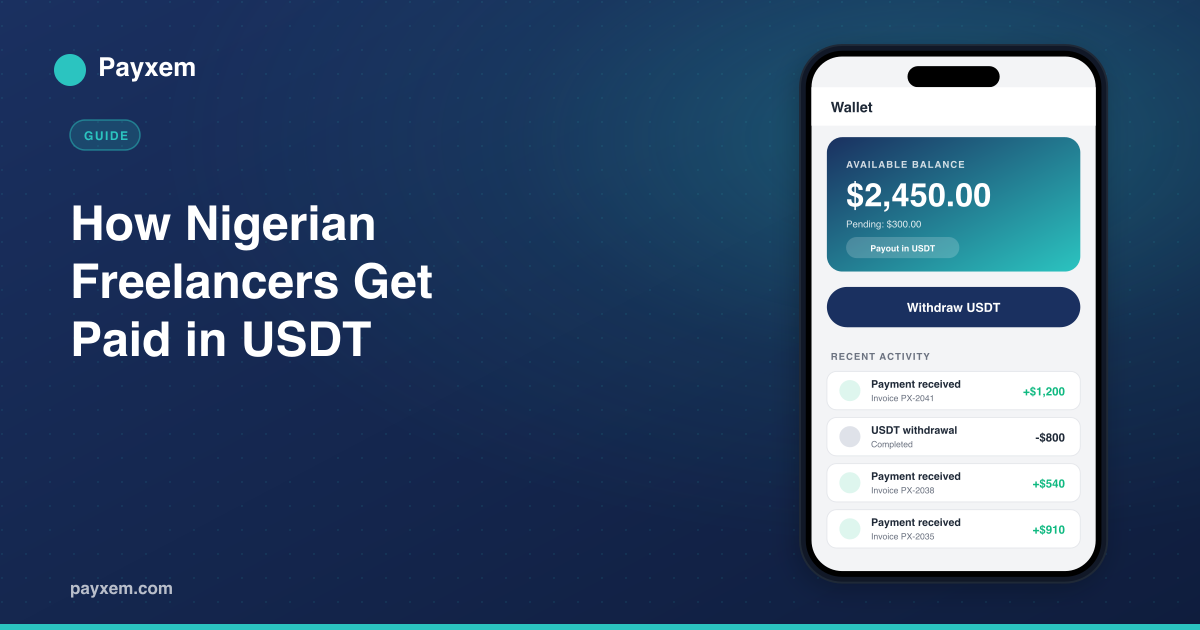
A proper dashboard shows your available balance, pending amounts, and full transaction history, so nothing gets lost.
Step 5. Understand Your Fees
Always calculate before you accept a payment:
- Payment processor fee (the card or PayPal percentage your client’s payment carries)
- Currency conversion (the exchange rate applied)
- Platform fee (if you use an invoicing tool)
Knowing your real earnings helps you set rates that actually work.
Common Mistakes to Avoid
- Relying on a method that does not support Nigeria
- Not sending professional invoices
- Ignoring fees until withdrawal time
- Not tracking payments and losing money to confusion
Final Thought
Getting paid as a freelancer in Nigeria is not as hard as it used to be. The key is to keep it simple for your client, and take a payout that moves fast and holds its value.
Freelancers who structure their payment process properly get paid faster and more consistently.
Start now: Create a free Payxem account and send your first invoice in under 60 seconds.
Related reads: